First, Know What You’re Comparing
You may have seen references to two manga adaptations of The Apothecary Diaries — and that can make this feel like a three-way decision. It isn’t, at least not for English readers.
Only one manga has an official English release: the version drawn by Nekokurage, published by Square Enix. That’s the adaptation the anime is based on, and it’s the one on bookstore shelves right now. (A second manga illustrated by Minoji Kurata exists and sits closer in atmosphere to the light novel; an English edition of this version (published by Viz Media) is scheduled for release in Fall 2026.)
So the real choice is this: Nekokurage manga or light novel? Both are in English, both are actively being translated, and both cover the same story — in genuinely different ways.
The Light Novel — What It Is and What It Does Better
Maomao’s Inner Voice Is the Whole Point
The light novel is written almost entirely from inside Maomao’s head. Her bone-dry sarcasm — the flat, almost emotionless way she privately skewers everyone around her — her step-by-step medical reasoning, her cool read on palace politics: it’s present on nearly every page. The anime gives you flashes of it through narration. The manga compresses it into expression and reaction shots. In the novel, it’s constant, and it’s irreplaceable.
If what you loved most about Maomao was the way her mind works — the way she quietly sizes up a situation and runs the logic before anyone else has noticed there’s a problem — the light novel delivers that in a way no adaptation can fully match.
Court Politics and World-Building Go Much Deeper
The rear palace hierarchy, the power dynamics of the imperial court, the backstories of characters who get two or three scenes in the anime — the light novel unpacks all of it. Readers who want to understand why the court works the way it does, why certain alliances form, why specific customs constrain characters the way they do, will find the novel genuinely satisfying in ways the manga isn’t designed to be.
This isn’t padding. The political texture is part of what makes Maomao’s problem-solving feel earned.
Format, Availability, and Series Status
The light novel was written by Natsu Hyuuga with illustrations by Touko Shino. In English, it’s available digitally through J-Novel Club — an English-language digital subscription service specializing in Japanese light novels, where you can subscribe for access to the full library or purchase volumes individually. Print editions are available from Square Enix Manga & Books (print editions began May 2024). 15 volumes are available in English. Print volumes typically run $15–20.
One thing worth knowing before committing: the original Japanese light novel is ongoing — the Japanese edition currently has 16 volumes published, with the series continuing. English translations are still catching up.

The Apothecary Diaries 01 (Light Novel)
The Manga (Nekokurage) — What It Is and What It Does Better
The Anime Used This Version for a Reason
The Nekokurage manga is visually polished, expressive, and designed to pull you through the story on energy and momentum. If the anime’s look and feel is what hooked you, this is the manga that matches that experience directly — it’s not a coincidence that the anime drew from this adaptation.
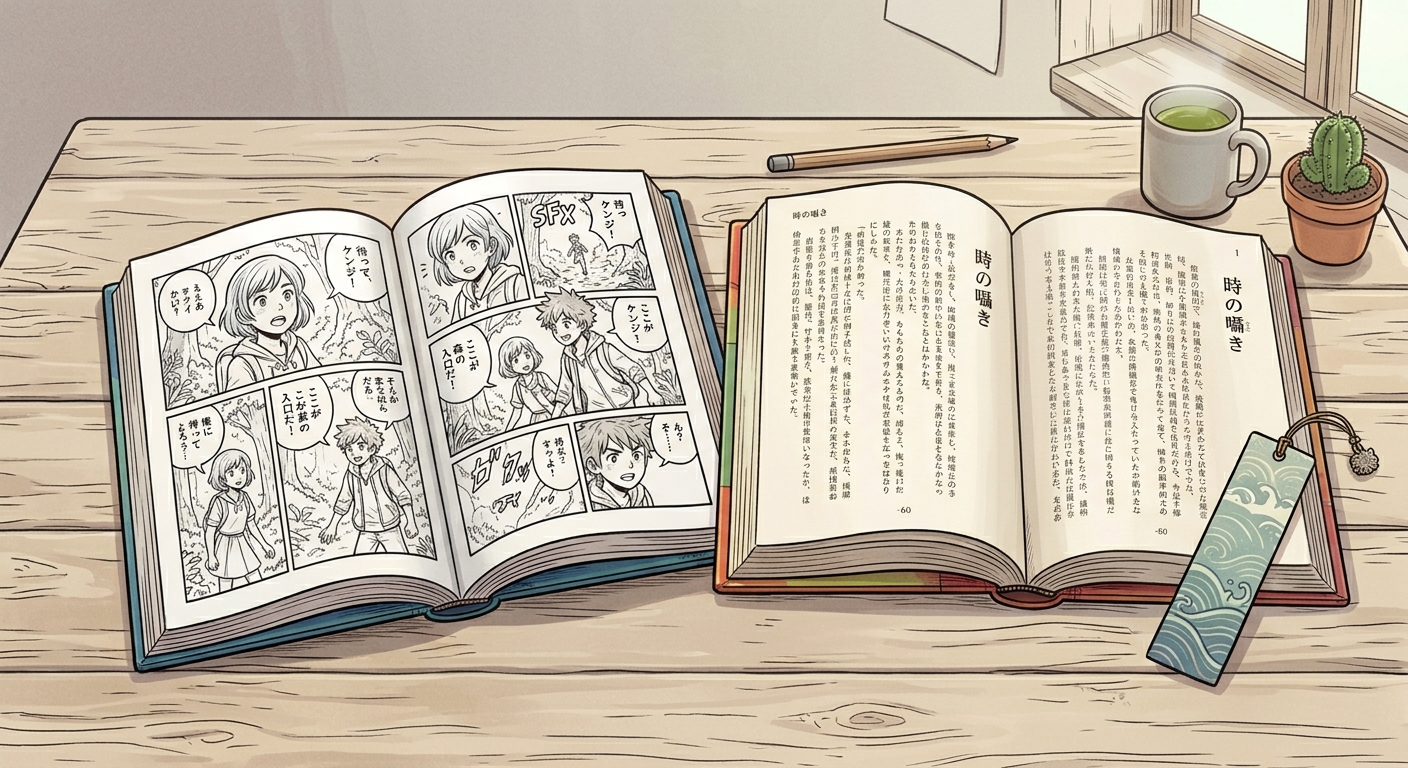
Manga tells its story through panels — individual framed images arranged across the page, with dialogue, expressions, and action distributed among them. The rhythm of how panels are sequenced, how a character’s face fills a frame at a crucial moment, how a reveal lands across a page turn — these are things visual storytelling does that prose can’t. The Nekokurage version uses all of that well.
The Romance Hits Different on the Page
This is the manga’s biggest edge over the light novel. Jinshi losing his composure, rendered across carefully composed panels. Maomao’s deadpan reaction to him, communicated through expression alone. The Nekokurage manga expands the romantic and comedic dynamic between these two significantly beyond what the light novel depicts — and it’s something prose simply cannot replicate.
If the Maomao-Jinshi dynamic is what you’re here for, the manga delivers it in a way that’s genuinely its own thing.
The Trade-Off: Slower Coverage, Condensed Inner Monologue
One light novel volume typically spans multiple Nekokurage manga volumes. The manga lingers and expands scenes — that’s a feature if you want more time in moments, but it means you’re covering less story per volume and per dollar.
Maomao’s medical reasoning and internal commentary, which runs so richly in the novel, gets condensed into facial expressions and visual shorthand. That works — good manga artists make that work — but it’s a different experience than following her logic step by step in prose.
Format, Availability, and Series Status
The Nekokurage manga is serialized in Monthly Big Gangan (Square Enix) — meaning new chapters are published monthly in Japan and later collected into volumes. The manga is still ongoing in Japan, so this is a longer-term commitment than the light novel. 15 volumes are available in English. Volumes typically run $13–15.

The Apothecary Diaries 01 (Manga)
Manga vs Light Novel: Side-by-Side Differences
| Feature | Manga (Nekokurage) | Light Novel |
|---|---|---|
| English available? | Yes — 15 volumes | Yes — 15 volumes |
| Maomao’s inner voice | Condensed into visuals | Rich, present on nearly every page |
| Romance emphasis | Expanded and visual — manga’s biggest strength | Present but lower-key |
| Mystery / medical logic | Shown through panels | Step-by-step in prose |
| World-building depth | Streamlined | Extensive |
| Story coverage per volume | Slower — expands and lingers | Faster — denser per volume |
| Art / visuals | Expressive, anime-style panels | Light illustrations only |
| Price (approx. US) | ~$13–15 per volume | ~$15–20 per volume (print) |
| Reading speed | Fast (visuals are processed quicker than prose) | Moderate |
| Series status (Japanese) | Ongoing | Ongoing |
Which Should You Choose?
Go with the Manga if…
- The Maomao-Jinshi romance is your main reason for continuing the story
- You want the reading experience to feel close to the anime in art style and energy
- Visual storytelling — expressions, reactions, the way tension builds across panels — is what draws you to manga in general
- You’re newer to manga or light novels and want the lower barrier to entry
Go with the Light Novel if…
- Maomao’s internal voice was the thing that got you — the dry sarcasm, the clinical logic, the way she notices everything — and you want more of that, not less
- You found yourself wanting more context on how the imperial court actually functions
- The mystery and medical reasoning feel as important to you as the characters
- Reading regular fiction (text-based novels) is comfortable for you, or you’re open to trying it — light novels are generally more accessible than literary fiction, and this one in particular moves quickly
Can You Do Both?
Absolutely — and they complement each other well. A lot of readers use the light novel for the depth and inner monologue, then return to the manga for the visual romantic moments that prose handles differently. There’s no required order here: some readers prefer the manga first to ease into the story, then the novel for more detail; others go novel first. Both work. The formats genuinely add to each other rather than just duplicating the same experience.
A Note on Where to Start After the Anime
If you’ve already watched the anime and want to pick up where it left off — without re-reading the same story — the right entry point is different for the manga and the light novel. See our guide → Where to Start Apothecary Diaries After the Anime for the specifics on both formats.
Quick Buying Guide
Both formats start at volume 1 and are easy to find. The light novel is also available digitally through J-Novel Club (subscription or per-volume purchase) if you’d rather not buy print — it’s often the cheaper option for reading ahead quickly.
The Apothecary Diaries 01 (Manga)
The Apothecary Diaries 01 (Light Novel)
Leave a Reply