Why Do You Read Manga Backwards? The Culture Shock for New Readers
You’re not alone. It happens to almost every first-time manga reader. You crack open what looks like the front cover, start reading from the left side of the page like you always would — and within seconds, something feels deeply, hilariously wrong. Characters are mid-sentence. A punchline lands before the setup. Someone is dramatically reacting to something that hasn’t happened yet.
Here’s the truth: you opened the book from the wrong end. And honestly? That moment of confusion is practically a rite of passage for new manga readers worldwide.
The good news is that learning how to read manga panels correctly takes about five minutes — and once it clicks, it becomes so natural you’ll never have to think about it again. This guide will walk you through everything you need to know, from the golden rule of reading direction to navigating tricky panel layouts and speech bubbles. Let’s dive in.
The Golden Rule of Manga Reading Order: Right to Left, Top to Bottom
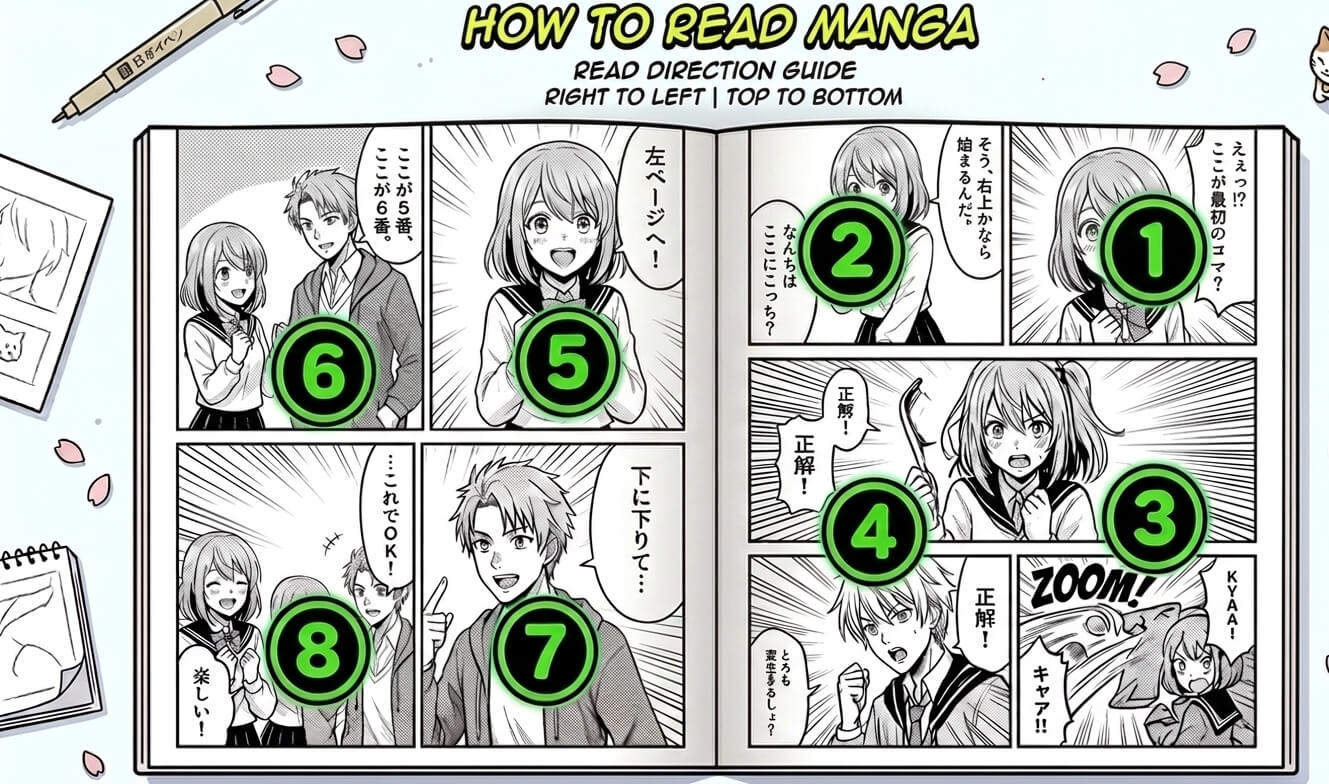
Before anything else, burn this one rule into your brain: manga is read from right to left. This applies at every level — the book itself, each individual page, every panel, and the order of speech bubbles within those panels. It is the complete opposite of how English books flow, and it’s the single biggest adjustment new readers need to make.
This isn’t a quirk or an accident. It comes directly from the roots of the Japanese writing system. Traditional Japanese is written in vertical columns that run from top to bottom — and those columns are ordered from right to left across the page. So when you finish one column, your eye naturally travels to the next column to its left, continuing to move across the page from right to left overall. Manga inherited this exact flow from centuries of Japanese literary and artistic tradition, making right-to-left the natural, authentic direction for the medium.
When Japanese publishers first began releasing manga internationally, many “flipped” (or “flopped”) the pages — mirroring every panel so the book could be read left to right. But this practice fell out of favor. Mirroring creates unintended problems: a right-handed swordsman becomes left-handed, text on signs reverses, and artists felt their original compositions were compromised. Today, reading manga in its original right-to-left format is considered the authentic experience, and most publishers proudly preserve it — often with a small note inside the back cover that cheekily reads: “You’re reading the wrong way!”
So take your manga, flip it over, and open it from what looks like the back. That is your front cover. You’re already off to a great start.
Step-by-Step Guide: How to Read Manga Panels Like a Pro
Now that you know the overall manga reading order, let’s break down exactly how to move through each page. The manga panel layout can look intimidating at first glance — pages are sometimes packed with large panels, tiny panels, overlapping frames, and speech bubbles scattered everywhere. But there’s a clear, consistent system underneath it all.
-
Start at the top-right corner of the page.
Every manga page begins at its top-right corner. Find the first panel there — that’s your entry point. It’s always the top-right corner, no matter how many panels are on the page or how they’re arranged. -
Read panels from right to left across each row.
Once you’re in the top-right panel, continue moving leftward across the page to the next panel. When you reach the leftmost panel on that row, drop down to the next row — and start again from the rightmost panel. Repeat until you reach the bottom of the page. -
Inside each panel, follow speech bubbles right to left and top to bottom.
Within any given panel, speech bubbles follow the same right-to-left rule. If two characters are speaking, the bubble on the right belongs to whoever speaks first. Start there, then move left to the next bubble. When in doubt, follow the natural flow of conversation — if the dialogue feels oddly out of order, try reading the bubbles in the other direction. -
Read translated dialogue normally (left to right), but follow bubble placement right to left.
Here’s an important distinction that trips up many beginners. The placement of speech bubbles on the page follows the right-to-left rule — but the text inside each bubble in an English-translated manga is written in standard left-to-right English, just like any other book. Read the text within each bubble normally. The right-to-left rule governs which bubble you read first, not how you read the words inside it. (Note: if you ever read an untranslated Japanese edition, vertical Japanese text inside bubbles reads top to bottom.) -
When panels overlap or break the grid, follow the visual flow.
Manga artists love dynamic manga layouts — panels that bleed into each other, diagonal cuts, or full-page splash art. When the grid breaks, use common sense: follow the natural downward-right-to-left flow, and let the artwork guide your eye. Usually, the largest or most dramatic panel anchors the sequence, with smaller panels arranged around it in reading order. -
Sound effects are part of the art — enjoy them, don’t stress them.
You’ll often see large stylized Japanese characters (even in translated versions) splashed across action panels. These are sound effects (onomatopoeia), and they’re decorative as much as functional. Many localized editions leave them in Japanese with a small translated note nearby. They don’t need to be “read” in strict sequence — just absorb them as part of the atmosphere and energy of the page.
A Quick Visual Cheat Sheet for Manga Panel Reading Order
If you ever get turned around mid-page, remember this simple path:
- Top-Right panel → move Left → Top-Left panel
- ↓ Drop down to the next row
- Middle-Right panel → move Left → Middle-Left panel
- ↓ Continue downward
- Bottom-Right panel → move Left → Bottom-Left panel
- ↓ Turn the page and repeat from the Top-Right
This cheat sheet shows a three-row example, but the exact same rule applies to any page — whether it has two rows, four rows, or more. No matter how the page is divided, you always sweep right to left across each row, then drop down to the start of the next. Right to left across each row, then drop down. Always.
Navigating Speech Bubbles: Tips for Tricky Conversations
Speech bubbles are where new readers most commonly trip up, especially during fast-paced conversations between multiple characters. Here are a few tips to keep the dialogue flowing smoothly:
- The tail tells you who’s talking. Every speech bubble has a small pointed tail that leads toward the speaker’s mouth or head. When multiple bubbles crowd a panel, follow the tails to figure out who says what.
- Stacked bubbles for one character read top to bottom. If one character has two or three bubbles stacked vertically, read the highest one first and work downward.
- Thought bubbles are usually rounder and cloudier. These represent internal thoughts and follow the same right-to-left, top-to-bottom reading order as regular speech bubbles.
- Jagged or spiky bubbles signal urgency or shouting. The shape of the bubble is part of the storytelling — a sharp, spiky outline means the character is yelling, alarmed, or making an explosive declaration.
The 4-Koma Exception: Understanding Yonkoma Manga Reading Direction
Once you’ve got the standard manga reading order down, there’s one special format worth knowing about: Yonkoma (4コマ漫画), also called 4-koma manga.
Yonkoma is a vertical comic strip format made up of exactly four panels stacked in a single column — always read from top to bottom. It’s the manga equivalent of a newspaper comic strip: quick, self-contained, and designed to land a punchline or emotional moment by the fourth panel. This top-to-bottom reading within the strip is the one constant rule of the format, and it’s the most important thing to remember.
Popular series like Azumanga Daioh and Chi’s Sweet Home use this format. When a page contains two Yonkoma strips side by side, the familiar right-to-left rule applies at the column level — read the right column’s four panels top to bottom first, then move to the left column. However, it’s worth knowing that Yonkoma layouts can vary. Some pages feature just a single strip per page, while others use hybrid layouts that mix Yonkoma strips with standard manga panels. Some anthology magazines arrange multiple strips in less predictable configurations. Don’t panic if a page looks different from what you expect — when in doubt, the core rule always holds: read each 4-panel strip from top to bottom. The rest will follow logically from there.
Common Mistakes New Readers Make (And How to Avoid Them)
Mistake 1: Reading Large Panels Before Small Ones
A visually dominant, large panel can pull your eye before you’ve finished the surrounding smaller panels. Remember: size doesn’t determine reading order — position does. Always prioritize the panel furthest to the right on each row, regardless of how big or small it is.
Mistake 2: Skipping Sound Effects
Sound effects in manga aren’t just decoration — they often carry real emotional weight. A well-placed WHOOSH or bone-crunching impact noise is part of how manga tells its story without words. Even if you can’t read the Japanese characters, the size, style, and placement of sound effects convey energy and rhythm. Let your eye absorb them as part of the full reading experience.
Mistake 3: Getting Lost on Full-Page Spreads
Sometimes two facing pages form a single massive image — a double-page spread. Many of these are pure, full-canvas illustrations with no additional panels at all, designed simply to be experienced as a single dramatic moment. When you encounter one, treat the two pages as one wide canvas: let your eye sweep from the far right edge of the right-hand page across to the left, taking in the full image. If there happen to be smaller panels below the main illustration, follow the same right-to-left rule to work through them. Either way, these spreads are reserved for the most powerful moments in a story — so pause, breathe it in, and then continue.
Why Does Manga Read Right to Left? The Answer Is in the Writing System
If you’re curious about the deeper reason behind manga’s right-to-left reading direction, it all comes down to the structure of the Japanese language itself. Traditional Japanese writing uses vertical columns of text that flow from top to bottom. Crucially, when a page has multiple columns, they are arranged and read from right to left across the page. So a reader finishing one column naturally moves to the next column to its left — their eye moving from right to left, column by column, until the page is complete.
Manga inherited this same spatial logic. Just as traditional Japanese books open from what Westerners would call the back and read “backwards,” manga flows in the same direction. It isn’t backwards at all from the perspective of the writing system it came from — it’s simply following a centuries-old tradition rooted in how traditional East Asian vertical scripts are structured.
That’s also why early attempts to “flip” manga for Western audiences always felt slightly off: the entire spatial grammar of the original artwork — the way a character’s gaze leads your eye, the rhythm of panels building tension — was designed for right-to-left flow. Reading manga in its original direction isn’t just authentic. It’s how the story was meant to be experienced.
How Long Does It Take to Get Used to Reading Manga Right to Left?
Here’s the most encouraging thing about learning manga’s reading direction: it becomes completely automatic far sooner than most new readers expect. For the vast majority of readers, the right-to-left flow stops feeling foreign within the first chapter or two. By chapter three, most people stop consciously thinking about direction at all — their eyes simply know where to go next.
The occasional stumble over a complex panel layout or a crowded speech bubble sequence is part of the fun. Every experienced manga fan has a story about reading a dramatic scene backwards and being completely baffled. It’s a universal experience, and it’s temporary.
The world of manga is extraordinary — filled with stories that will make you laugh, cry, stay up until 3 a.m. promising yourself “just one more chapter,” and see the world in new ways. All that stands between you and that experience is a small, quickly learned shift in how your eyes move across a page.
Learning to read manga right to left isn’t a barrier — it’s your first step into one of the richest storytelling traditions on the planet. Give yourself twenty pages, and that new direction will feel as natural as breathing. The story is waiting. Open to the right, and begin.
Leave a Reply