
The Best Manga Like Vagabond — and What Sets Each Pick Apart
Most “manga like Vagabond” lists throw out a dozen samurai titles and call it done. That’s fine, but it misses the point. Vagabond isn’t special because it has swords — it’s special for four very specific reasons, and the best recommendations actually match those reasons.
The five picks in this guide:
- Berserk — for the artwork and existential weight
- Blade of the Immortal — for feudal Japan swordsmanship with moral complexity
- Lone Wolf and Cub — for the foundation all samurai manga is built on
- Vinland Saga — for the “what does it mean to be truly strong?” question
- Rurouni Kenshin — for a samurai story that actually finishes
The four pillars that make Vagabond what it is:
- Historical grounding. Vagabond follows a fictionalized version of Miyamoto Musashi’s real life. Takehiko Inoue isn’t inventing a fantasy warrior — he’s reimagining a man who actually walked Japan. That historical weight changes everything about how the story feels.
- A philosophical arc — a character’s moral and emotional journey across hundreds of chapters — with real stakes. Musashi starts as a violent, directionless kid and spends the entire series trying to answer one question: what is strength actually for? The combat is almost secondary to that search.
- The artwork. Inoue works with actual ink and brushes, producing pages that look like moving paintings. This isn’t digital linework — it’s dense, expressive, and unlike almost anything else in manga.
- The VIZBIG format. VIZ Media publishes Vagabond in an oversized format that lets that brushwork breathe. The scale genuinely matters. This is not a series you want squeezed into a standard paperback.
Now, there’s something every new reader should know upfront: Vagabond has been on hiatus since May 2015 — meaning the author has stopped releasing new chapters indefinitely, with no confirmed date for when the series will continue. The last published chapter is chapter 327, “The Man Named Tadaoki.” The 2025 Definitive Edition from VIZ Media is a beautiful new reprint — not new content. Inoue stated in February 2025 that he “can’t wait to draw Vagabond” and wants to “reignite Musashi’s flame,” but no return date has been announced.
This doesn’t make Vagabond any less worth reading. What exists across 12 VIZBIG volumes is genuinely one of the most extraordinary runs in manga. But knowing this before buying a full set matters.
The picks below are each matched to a specific Vagabond quality, not just “it has samurai in it.” Here’s how to find your next read.
Berserk — If You’re Here for the Art and the Existential Dread
If what pulls you toward Vagabond is the feeling of holding a page and thinking “how did someone draw this,” Berserk by Kentaro Miura is where you go next.
Miura’s crosshatching — a drawing technique where hundreds of tiny overlapping lines are stacked to build shadow, texture, and physical weight — achieves the same reaction as Inoue’s brushwork, just through a completely different method. Where Inoue uses loose, expressive ink that suggests motion, Miura builds armor, demons, and landscapes line by line until the page feels almost heavy to look at. Both artists treat every page like a canvas.
The philosophical parallel runs deep too. Guts, Berserk’s protagonist, starts as a man who has known nothing but violence and slowly, painfully confronts whether that violence defines him or destroys him. That’s the same question Musashi is living through in Vagabond. The framing is darker — much darker — but the soul of the question is identical.
Before you buy: Berserk is dark fantasy, not historical Japan. There are demons, blood sacrifice, and content that regularly pushes into horror. If Vagabond’s violence is on a scale of 3, Berserk runs at an 8 or 9. That’s not a criticism — just important context for what you’re walking into.
Where to start: Volume 1 of the Deluxe Edition. The series is designed to be read in order from the beginning.
Format tip: For the closest reading experience to VIZBIG, the Berserk Deluxe Edition from Dark Horse Comics — one of the major North American publishers of manga and comics — is the right call. Each Deluxe volume collects approximately three standard paperback volumes in a larger trim with higher-quality paper. 14 Deluxe volumes total.
Status: 42 volumes in the Japanese series. Miura passed away in May 2021; the series has been continued by Kouji Mori with Miura’s studio assistants and resumed in June 2022. The English release from Dark Horse currently stands at 42 volumes, ongoing.

Berserk Deluxe Edition, Vol. 1
Blade of the Immortal — If You Want Edo-Era Swordsmanship with Moral Complexity
Of everything on this list, Blade of the Immortal by Hiroaki Samura is the closest match to Vagabond on the surface: feudal Japan — specifically the Edo period (1603–1868), the era of shogunates and samurai that defines most classic samurai stories — obsessive swordsmanship, and characters who fight not to win but to define what they are.
Samura’s art style — scratchy, impressionistic, sometimes rough in ways that feel entirely deliberate — shares Inoue’s looseness. Both artists reject the clean, precise linework of mainstream manga in favor of something messier and more expressive. If Vagabond’s artwork was the first thing that stopped you cold, Blade of the Immortal will do the same thing to you.
The philosophical twist: protagonist Manji has been cursed with immortality and tasked with killing 1,000 evil men to earn the right to die. That’s a harder version of the same question Vagabond asks — instead of seeking what strength is for, Manji is trying to make his violence count for something in a context where his own death doesn’t even register. It’s a harder angle on the same problem, and it hits.
This is also the one that most comparable recommendation lists skip. It’s not as well-known as Berserk, and plenty of lists focus on action over art. If you’ve already read the most commonly recommended titles, Blade of the Immortal is very likely the one you haven’t tried yet.
Published by Dark Horse Comics. 31 English volumes. Complete — no wait, no hiatus, just a finished story. A Dark Horse oversized Deluxe Edition is also available for readers who want the larger-format experience.
Where to start: Volume 1. The story is sequential and builds from the beginning.

Blade of the Immortal Omnibus, Vol. 1
Lone Wolf and Cub — If You Want the Foundation All Samurai Manga Is Built On
Before Vagabond, before Berserk, before any of the modern samurai manga, there was Lone Wolf and Cub. Written by Kazuo Koike and illustrated by Goseki Kojima, it’s the series that defined what a lone warrior walking Japan could look and feel like — and Inoue didn’t invent that archetype, he inherited it.
Reading Lone Wolf and Cub alongside Vagabond makes both series richer, because you start seeing exactly what Inoue was drawing on and where he went his own way.
The philosophical parallel is sharp: Itto Ogami walks a road of vengeance — a path he has chosen in full knowledge that it leads nowhere good — with his young son Daigoro after their clan is destroyed. He has stripped himself of everything except purpose. That nihilism — the warrior who has rejected all human attachment in service of the sword — is where Musashi begins in Vagabond. Ogami never moves past it. Musashi spends the whole series trying to.
Kojima’s compositions are cinematic in a way that was genuinely ahead of their time — long horizontal panels, deliberate empty space used to build tension and silence, a visual rhythm that influenced generations of manga artists after him.
Published by Dark Horse Comics. 28 volumes. Complete. The series ran in Japan from 1970 to 1976 and has been fully translated into English.
Where to start: Volume 1. The series is episodic — many chapters stand alone — but it builds cumulatively, and the beginning is the right place to start.

Lone Wolf and Cub, Vol. 1
Vinland Saga — If You’re Here for the “What Does It Mean to Be Truly Strong?” Arc
Among all the recommendations here, Vinland Saga by Makoto Yukimura has the most direct thematic connection to what Vagabond is doing at its deepest level.
Both series begin with a violence-obsessed young man and then spend hundreds of chapters forcing him to confront whether the sword was ever actually the answer. In Vagabond, that’s Musashi. In Vinland Saga, that’s Thorfinn — a Viking warrior whose entire identity is built around revenge, until the object of that revenge is taken away and he has to figure out who he is without it.
The second half of Vinland Saga — where Thorfinn attempts to build a pacifist settlement — is structurally what Vagabond’s final story direction feels like it has been leading toward: a man of violence choosing something entirely different. If you’ve ever wondered where Musashi’s story might end, Thorfinn’s may be the closest existing answer.
The setting is Norse and Viking, not Japan. The art style is cleaner, more precise. But the question at the center of both series is identical, and Vinland Saga has the enormous advantage of being finished.
Published by Kodansha USA in a hardcover format where each book contains two original Japanese volumes. The Japanese series concluded in July 2025 with 29 volumes. Note that the English translation runs behind the Japanese release — as of April 2026, the final volumes have not yet been published in English, so readers will need to wait for the remaining hardcovers. The English release currently stands at 14 hardcover volumes, with more to come. No hiatus risk — the story is complete in Japanese, and English volumes are releasing on schedule.
Where to start: Volume 1 of the Kodansha hardcover edition. Read in order.

Vinland Saga Hardcover, Vol. 1
Rurouni Kenshin — If You Need a Samurai Story That Actually Finishes
This one is a little different from the rest of the list. Rurouni Kenshin by Nobuhiro Watsuki doesn’t dig as deep into philosophy as Vagabond, and its artwork is more conventional. But it earns its place here for two specific reasons.
First: Kenshin Himura’s story — a former assassin who has sworn never to kill again and must protect people with that vow intact — covers the same moral ground as Vagabond in a more optimistic, more resolved way. Both series ask whether a man built for violence can become something else. Vagabond leaves that question open. Rurouni Kenshin answers it, warmly and completely.
Second: VIZ Media published Rurouni Kenshin in the same VIZBIG format as Vagabond. All 9 VIZBIG volumes cover the complete series. Readers already familiar with how Vagabond VIZBIG works will find the format identical — same publisher, same oversized trim, same color pages, complete story.
If you’re newer to this corner of manga and want the samurai atmosphere without committing to something incomplete, Rurouni Kenshin is a genuinely satisfying place to start. Go in knowing it’s a warmer, more adventure-focused story — less raw than Vagabond, but not lesser for it.
One important note: Author Nobuhiro Watsuki was charged with possession of child pornography in 2017 and received a suspended fine. This is widely discussed in the manga community and worth factoring into your decision before buying.
Where to start: VIZBIG Volume 1. The 9 VIZBIG volumes cover the complete story in order.

Rurouni Kenshin VIZBIG Edition, Vol. 1
How to Buy Vagabond: VIZBIG Edition vs. Definitive Edition (What No One Explains)
If you’re new to Vagabond and confused about which edition to buy, you’re not alone — most resources skip past this entirely.
First, a quick note on how manga editions work: manga is originally published in Japan as small paperback volumes of around 200 pages each. Publishers then create collected editions for international release that bundle multiple original volumes into one larger book — which is why Vagabond’s 37 original Japanese volumes become just 12 oversized English volumes.
| Edition | What to Know |
|---|---|
| VIZBIG Edition | 12 volumes covering the complete English release (through chapter 327). Each volume collects approximately 3 original Japanese volumes in oversized trim with color pages. Widely available. The proven entry point. |
| Definitive Edition (2025) | A premium new printing launched January 2025 by VIZ Media — same story content as VIZBIG, with higher-quality paper and materials. Also collects approximately 3 original Japanese volumes per volume. Still releasing — not yet complete in English. |
For most new readers: start with VIZBIG Volume 1. It’s the right format, it’s available now, and there’s no reason to wait for the Definitive Edition to complete before discovering whether Vagabond is for you.
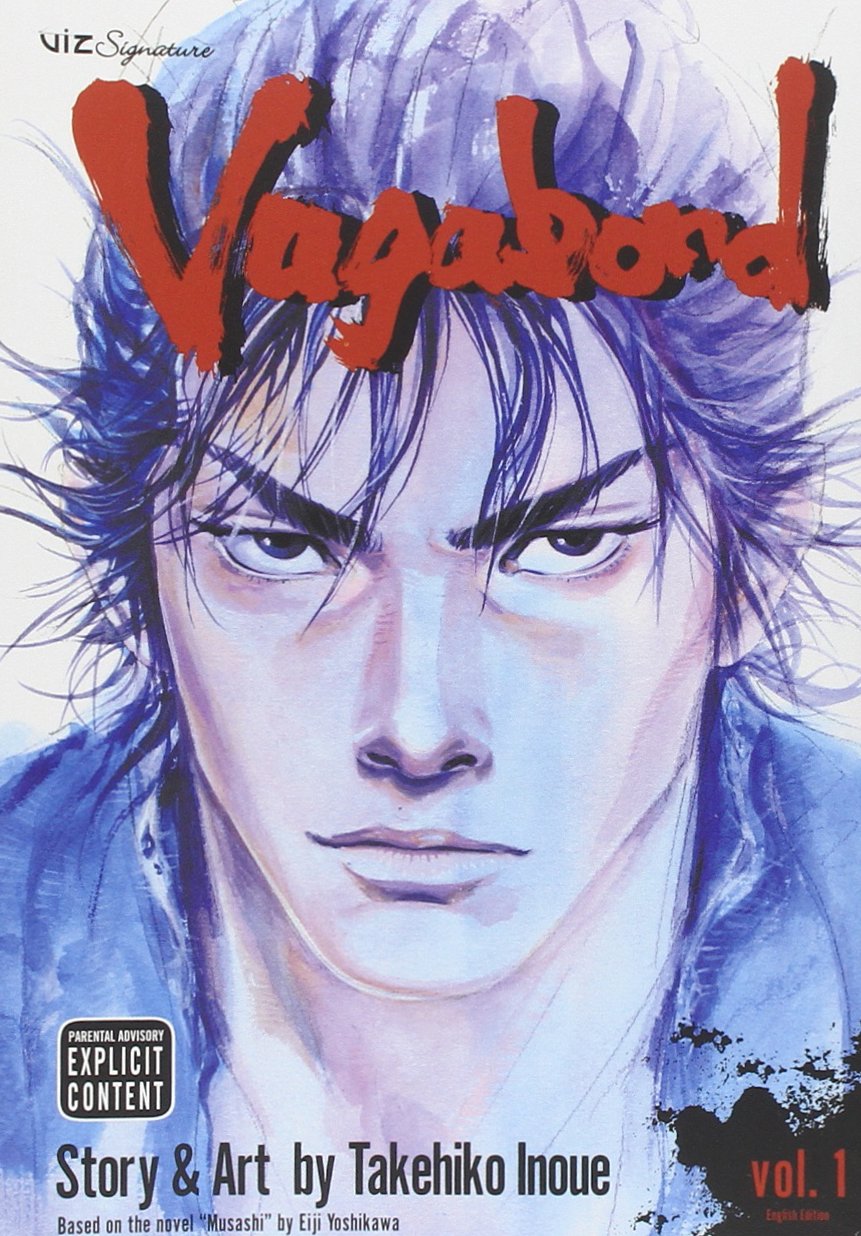
Vagabond, Vol. 1 (VIZBIG Edition)
One thing to know before buying a full set: Vagabond ends at chapter 327. The story is not finished. The series has been on hiatus since May 2015, and what exists across all 12 VIZBIG volumes does not resolve the central arc. Inoue has expressed his desire to return — but no return date is confirmed.
That said: what exists is extraordinary. The hiatus isn’t a reason to avoid Vagabond — it’s just useful information for a buyer deciding whether to grab a full set upfront or start with Volume 1 and go from there.
Honestly, just pick up Volume 1 and see how it feels. Most readers know within the first chapter whether this is a series that’s going to take hold of them. It probably will.
Leave a Reply